
## Metadata
- Author: [[archive.is]]
- Full Title:: How Anthropic Enables Self-Service Data Analytics With Claude | Claude
- Category:: #🗞️Articles
- URL:: https://archive.is/4c8UV
- Read date:: [[2026-08-21]]
## Highlights
> Coding is an open-ended solution space that rewards the models' creativity, while documentation and tests provide natural guardrails against hallucination. In contrast, for analytics use cases, there’s often only a single correct answer using a single correct source in which there’s no deterministic way of proving the correctness. ([View Highlight](https://read.readwise.io/read/01m0fg7harqd12qjqkvfggkr7m))
> 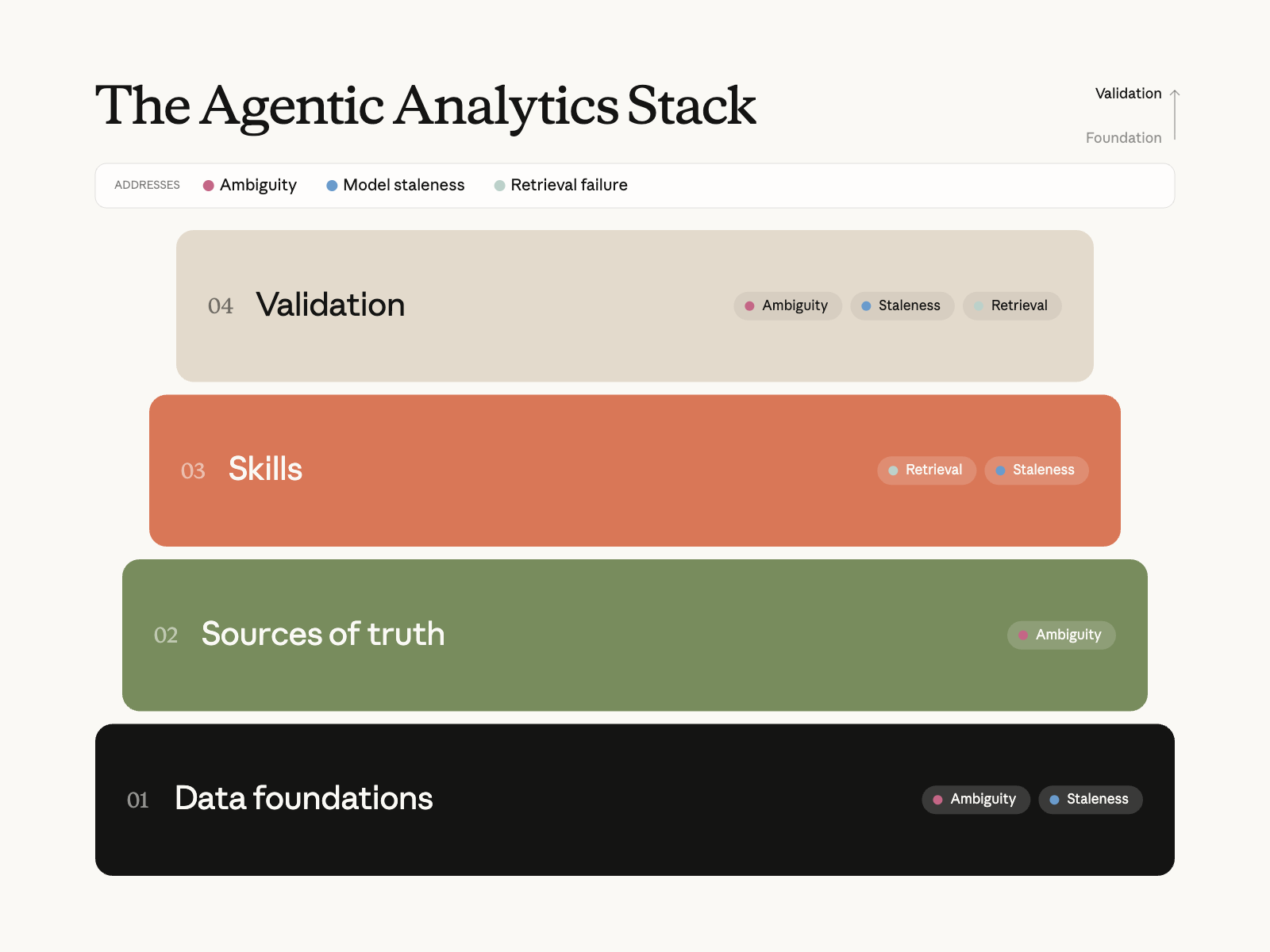 ([View Highlight](https://read.readwise.io/read/01m0fg8d20fkyx0fvvkrsfdg59))
> Standard data engineering and data quality practices such as [dimensional modeling](https://archive.is/o/4c8UV/https://en.wikipedia.org/wiki/Dimensional_modeling), shift-left testing, freshness and completeness checks on critical pipelines all still apply (and we won't relitigate these). ([View Highlight](https://read.readwise.io/read/01m0fg8tqgwchrc4vqp0m799xh))
## New highlights added [[2026-09-04]]
> The data foundations layer is aimed primarily at ambiguity: if *revenue*, for example, resolves to one governed dataset instead of forty plausible candidates, the problem largely disappears before the agent ever has to search. ([View Highlight](https://read.readwise.io/read/01m1nm42dk7jwwpxm2a1cr188e))
> What does work is distilling that corpus into structured per-domain reference docs and reusable analysis patterns described in **skills**. ([View Highlight](https://read.readwise.io/read/01m1nm5acwpr83gmgegpca3qjw))
> We pipe in a company knowledge graph consisting of indexed docs, roadmaps, decision logs, and our organizational structure so the agent can resolve ambient references and ask better clarifying questions. ([View Highlight](https://read.readwise.io/read/01m1nm5r7x56n4vxed5wvh6d1a))
> **Adversarial review**: we’ve found that employing a Claude skill to aggressively challenge all underlying assumptions on a potential final answer increased accuracy by 6% within our eval set, but at the cost of 32% more tokens and 72% higher latency. ([View Highlight](https://read.readwise.io/read/01m1nm9r2sg19d9cm0dpea1anc))
> **Provenance footer:** every response carries a footer that contains which source tier it came from (semantic layer › curated reference › raw table), how fresh the underlying data is, and who owns the model. It doesn't make the answer more correct, but it does help the consumer judge how much they can trust the response. A "raw table, freshness unknown" footer is a signal to verify before forwarding upstream, and it's one of the few mitigations we have for silent failures. ([View Highlight](https://read.readwise.io/read/01m1nma1xtc4288arpcfc26a4h))